Running Gait Analysis · Sedgley, Dudley, Wolverhampton & Online
Running Form Analysis: In Person or Online Video Assessment
Find out exactly where your running is leaking energy — and get a clear plan to fix it. A whole-body gait and form analysis from former GB marathon runner Martin Williams (2:17:36 PB), not a two-minute treadmill check in a shoe shop.
- £99 complete assessment
- In person or remote video
- Detailed written report
- Drills + strength + 12-week plan
In short
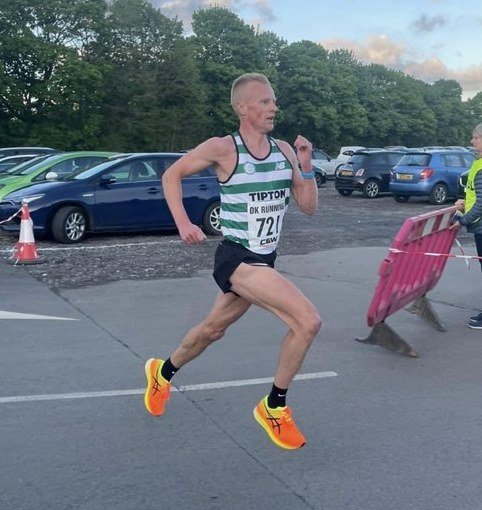
Runners Route running form analysis costs £99. You are filmed from three angles (side, front and behind) — in person near Sedgley, between Dudley and Wolverhampton, or from your own phone videos if you live further away. Martin reviews the footage frame by frame and sends a detailed written report: what you already do well, the one root habit costing you most, ranked priorities, simple running cues, a three-tier drill programme, a strength programme and a 12-week plan to make the change permanent.
Who It Helps
- Runners who keep picking up the same niggle — and want to know whether the way they move is adding to it.
- Runners who have plateaued — the fitness is there, but the times aren't moving.
- Marathon runners who fade in the last 10k. Form that falls apart at mile 20 is costing you minutes over 35,000–45,000 steps.
- Newer runners who want to build good habits before the mileage goes up.
- Coached athletes and club runners who want a second pair of expert eyes on their technique.
Gait Analysis vs Running Form Analysis
“Running gait analysis” usually means one of three quite different things:
- Shoe-shop gait analysis — a short treadmill clip of your feet, mainly to judge how much your foot rolls inwards and recommend a shoe. Useful for buying shoes; it says little about how you actually run.
- Clinical or lab biomechanics — 3D motion capture or force plates, usually with a physio or sports scientist, often used for injury rehabilitation.
- Running form analysis (this service) — a coach's whole-body look at how you run, from the arms down to the feet, why it matters for you, and exactly what to do about it.
Most runners don't need a lab. They need someone who has spent a career running and coaching to watch them properly, find the root cause rather than a list of ten faults, and give them a plan they can actually follow. Read more in the guide What Is Running Gait Analysis — and Which Type Do You Need?
What's Included for £99
1. Filming from three angles
Side on, running towards the camera and running away from it. In person, or from three short clips you film yourself on a phone.
2. Frame-by-frame review
Key frames are pulled out and marked up so you can see exactly what is happening — for example, where your foot lands against a line dropped from your hip.
3. What you already do well
Your strengths matter. They tell us what to protect and what the new pattern can be built on.
4. The root cause, not a list of faults
Most “faults” are one habit seen from different angles. Fix the root and the rest usually follows.
5. Ranked priorities and cues
What to work on first, second and third — and a few short cues you can hold in your head while you run.
6. Three-tier drill programme
Teach the movement, load it and speed it up, then put it into your real running. About ten minutes before a run.
7. Strength programme
Two short sessions a week targeting what you need to hold the new shape when tired — trunk control, upper back, calves, glutes.
8. 12-week plan and re-checks
A block-by-block plan, a sample week and clear points at which to re-film yourself so you can see the change is sticking.
What Is Assessed
Every runner is different, so the report focuses on what genuinely matters for you. The analysis covers:
- Arm carriage — direction, height and whether the arms cross the body.
- Posture and trunk rotation — running tall, and whether the shoulders and hips are twisting against each other.
- Foot landing and overstriding — where the foot touches down relative to your hips, and whether you are braking on every step.
- Leg recovery and push-off — how the back leg folds and how well you extend behind you.
- Knee and foot tracking from the front and behind.
- Cadence — measured as your own baseline, never forced towards a magic 180.
- Left–right differences that show up across the clips.
Footage is honest about its limits too. If you are filmed striding faster than race pace, that is explained, and the plan includes filming you again at your goal pace and late in a long run, when old habits come back.
How It Works
In person (near Sedgley, Dudley and Wolverhampton)
We meet outdoors, film you running from three angles, talk through what we see and go through your first drills together so you know how they should feel. Runners regularly come from Dudley, Wolverhampton, Wombourne, Stourbridge and Birmingham. If you also need treatment, it pairs well with a sports massage.
Online (anywhere in the UK or abroad)
You film three short clips on a phone — side on as you run past, running towards the camera and running away from it — on a flat path, at an easy pace and a faster pace. Full filming instructions are sent when you book. You get exactly the same written report and programme.
After the assessment
You'll receive your report with the drills, strength work and 12-week plan. Questions are welcome at any point. Many runners then move into online coaching so the form work is built into their weekly training, but there is no obligation.
Why Martin?
Martin Williams started running at 25 while working shifts as a police officer and went on to run 2:17:36 for the marathon, win the Edinburgh Marathon, become Scottish Marathon Champion and represent Great Britain at the 2010 European Championships and Scotland at the 2010 Commonwealth Games. He is an England Athletics licensed coach and ITEC qualified sports therapist, so he looks at movement as both a coach and a therapist.
“Martin began by asking my son to run and then analysed his technique. He identified that the issue was related to his IT band and proceeded to massage the affected areas. He then showed him appropriate exercises to help strengthen his glutes. I would highly recommend Martin.”— Jenny Thorpe, Google review
“I've seen real improvements not just in recovery, but in how efficiently I move and train.”— Todd Quiney, Google review
An Honest Note on Injuries
This is a coaching assessment, not a medical diagnosis. It can show movement habits that may be adding load to particular areas, and give you a plan to change them. It cannot promise to prevent or cure an injury. If you have pain, swelling or a current injury, you will be told plainly if you should see a physiotherapist or GP first.
Running Form Analysis FAQs
How much does a running gait analysis cost?
£99 for the complete assessment: filming, frame-by-frame review, written report, ranked priorities, drills, strength programme and 12-week plan.
Is this the same as a shoe-shop gait analysis?
No. A shoe-shop check looks mainly at how your foot rolls in order to sell a shoe. This looks at your whole body — arms, posture, trunk, landing, leg recovery and push-off — and gives you a plan to change what matters.
Can I have my running form analysed online?
Yes. Film three short clips on a phone (side, front and behind) and send them over. You receive the same report and programme as an in-person session.
Where are in-person assessments held?
Outdoors near Sedgley, between Dudley and Wolverhampton. Exact location is agreed when you book.
Will it fix my injury?
It is not a medical diagnosis. It can identify habits that may be adding load and give you a plan to change them. If you need a physio first, you will be told.
Do I need to change my foot strike?
Usually not directly. Heel striking is mainly a problem when your foot lands well ahead of your hips. That is normally fixed higher up — arms, posture and a small cadence nudge — rather than by trying to run on your toes.
What should I wear?
Your normal running kit and the shoes you train in. Fitted clothing helps the camera see your hips and knees.
Book Your Running Form Analysis — £99
Tell Martin a little about your running and whether you'd like to be filmed in person or send videos. You'll get a reply with next steps and filming instructions.
Related
- Online running coaching — build the form work into a personalised weekly plan.
- Marathon coaching — from first marathon to sub-3.
- Strength training for runners: what actually matters
- Running coach in Dudley · Wolverhampton · Birmingham