Blog · Threshold Training · Norwegian Method
The Norwegian Paradox: Why Doing Less Intensity Might Be the Key to Your Next PB
Most runners do not need more suffering. They need better control. The Ingebrigtsen model shows why mastering threshold, easy running and metabolic stability can beat another heroic workout that ruins the next three days.
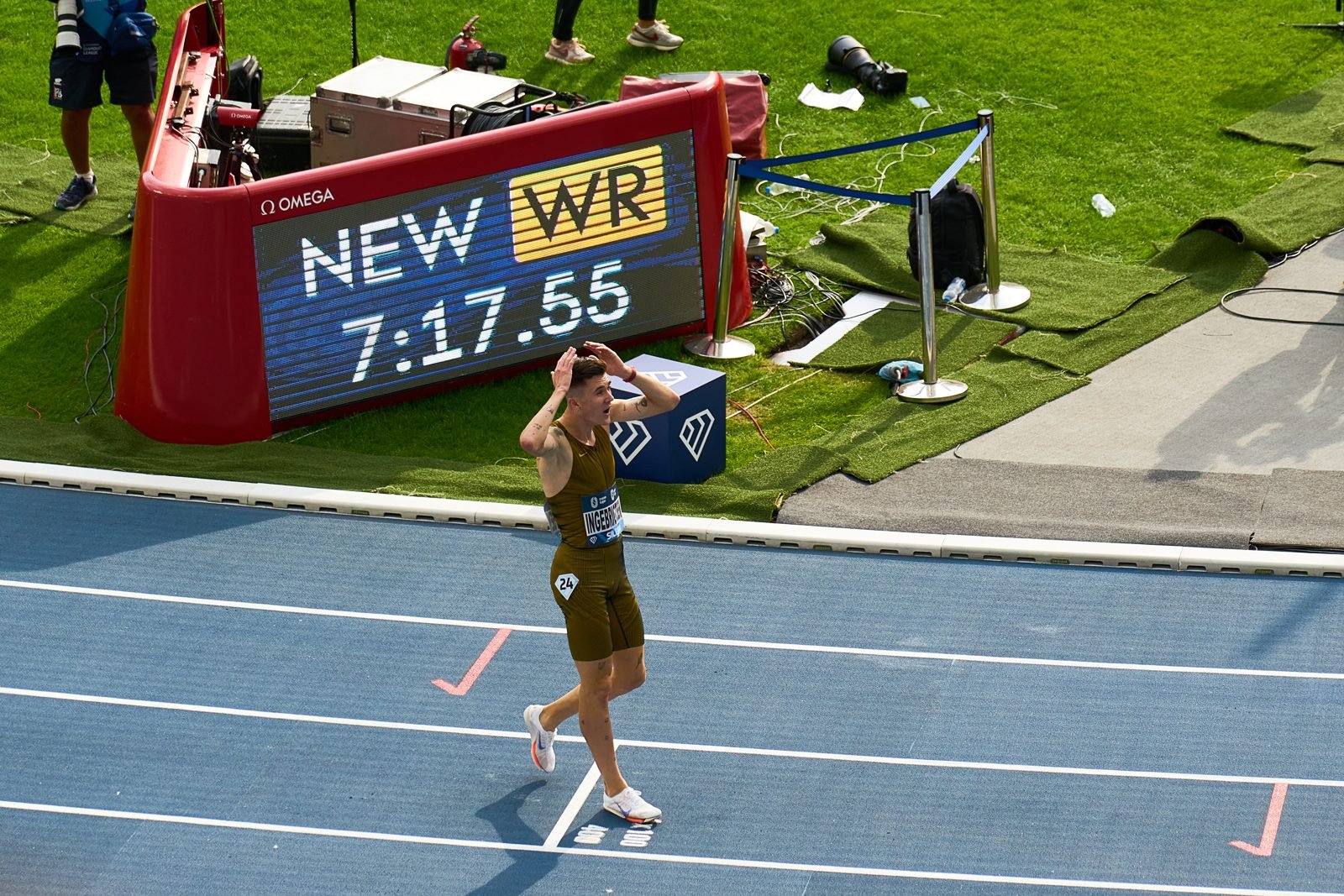
Quick answer for runners
The Norwegian method works because it controls effort. Instead of drifting into the moderate intensity “black hole”, runners accumulate more work near threshold, keep easy days genuinely easy, use short recoveries to practise speed without lactate blow ups, and protect consistency with hills and strength work.
1. The Hook: The Plateau Paradox
For many runners, training follows a predictable and frustrating trajectory. You log the miles, endure gruelling tempo runs, and finish every session exhausted. Yet, after an initial period of improvement, the progress halts. You have entered the black hole of moderate intensity training, a physiological dead zone where you are working too hard to recover, yet not specifically enough to trigger new adaptations.
This plateau is not a failure of effort, but of architecture. In traditional models, runners often suppress their progress by ignoring the cellular pathways of adaptation. To overcome the plateau, one must move beyond running hard and focus on the signalling pathways that drive mitochondrial biogenesis, specifically the AMPK and calcium signalling pathways. These are the engines of endurance, and they are optimised not by maximal effort, but by the precise management of physiological stress.
The gold standard for this architectural shift is the Ingebrigtsen family. With Jakob Ingebrigtsen’s Olympic and World Championship dominance serving as the proof of concept, their success has forced a global re-examination of endurance science. Their method is built on the realisation that understanding internal load, the metabolic cost of a run, is far more vital than the pace on a GPS watch. To get faster, you must stop trying to win your workouts and start mastering your metabolic stability.
2. Takeaway 1: The Power of Clustering, or Double Thresholds
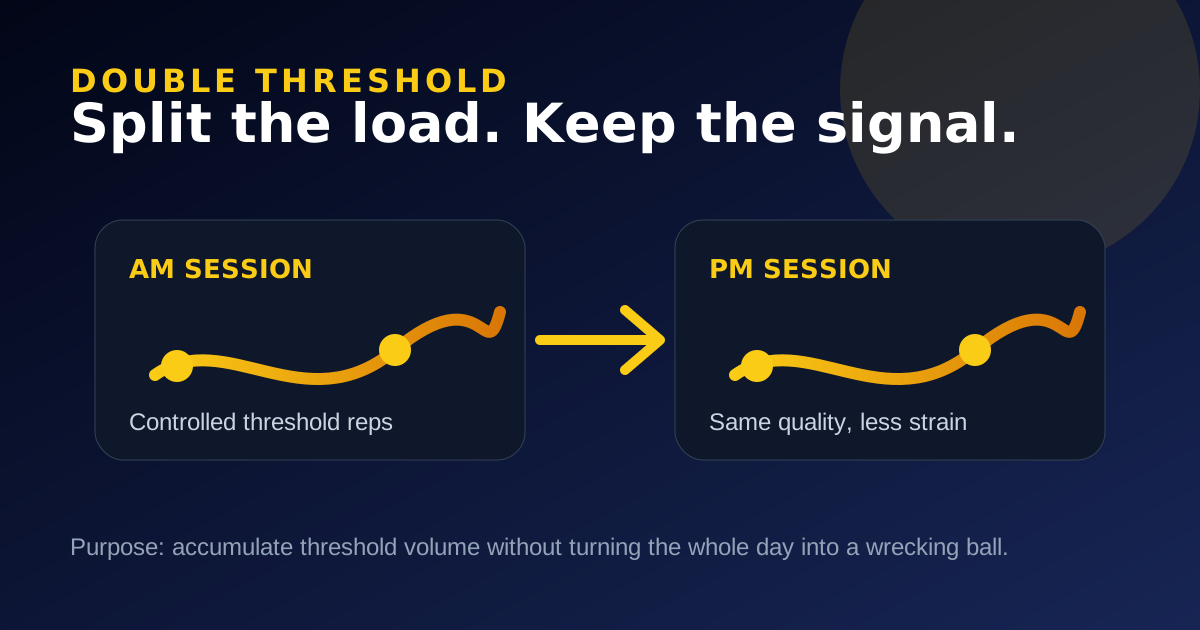
The most striking feature of the Norwegian method is the double threshold day: performing two distinct threshold sessions within a single 24 hour period, typically on Tuesdays and Thursdays. While conventional wisdom suggests that more rest between hard sessions is the only route to recovery, the Norwegian model uses clustering to maximise volume while minimising systemic wear.
The logic is validated by the Talsnes 2024 study, which compared one long threshold session against two shorter sessions of equal total volume. The findings revealed that splitting the load reduced heart rate, blood lactate levels, and the rate of perceived exertion.
“Splitting the same load across two sessions allows athletes to accumulate volume with less physiological stress, improving next day training continuity.”
By breaking the work into two bouts, athletes can accumulate a massive amount of quality time at their lactate threshold without the exponential spike in fatigue that occurs at the end of a singular, exhaustive session.
3. Takeaway 2: Speed as a Work to Rest Ratio
The counter intuitive core of the programme lies in its approach to speed, a metric the brothers redefine as a work to rest ratio rather than a raw pace. This is best illustrated by their 400m repeats. While many associate 400m reps with anaerobic sprinting, the Ingebrigtsens perform them at roughly 5,000m race pace, classifying them strictly as threshold training.
The objective is metabolic stability. By using short durations, such as 400m, and strictly controlled short rests, often 30 seconds, the body maintains high speeds without allowing blood lactate to spike into the red zone above 4.0 mmol/L. This allows the athlete to train the biomechanics of race pace without the corrosive metabolic cost. Notably, this volume is a product of long term development; Jakob progressed from 16 reps at a younger age to 20, and eventually to the 25 rep sets he performs today.
Standard staple workouts in this model
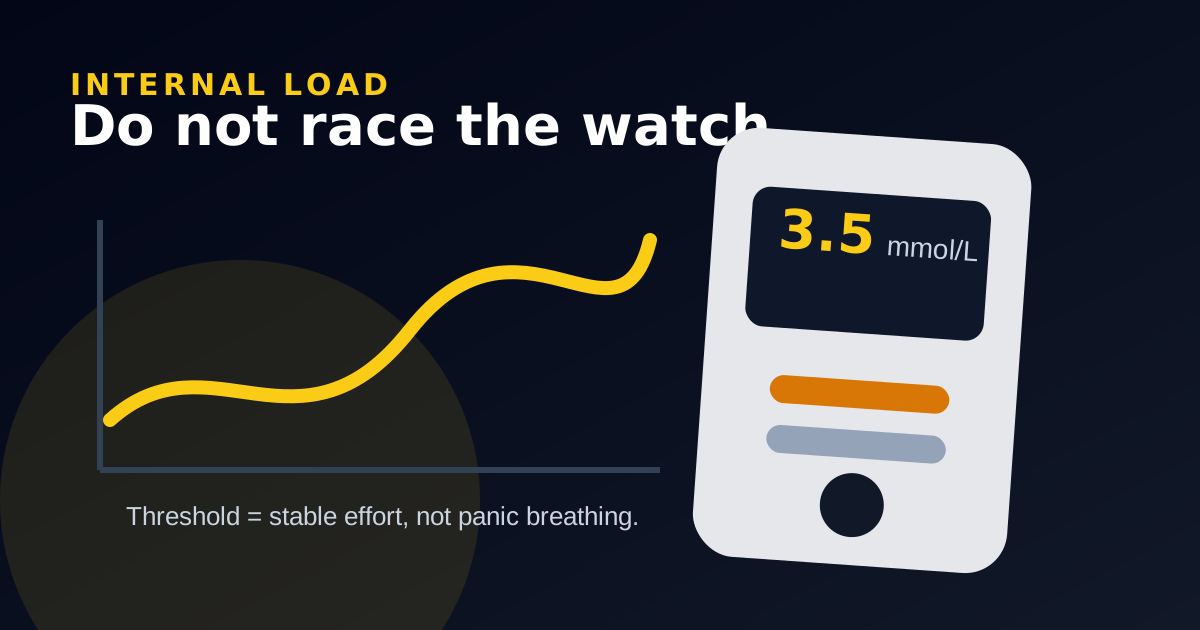
- 5,000m pace: 25 x 400m with 30 seconds rest. Target around 3.5 mmol/L lactate.
- 10,000m pace: 10 x 1,000m with 1 minute rest. Target around 3.5 mmol/L lactate.
- Half marathon pace: 5 x 2,000m with 1 minute rest. Target around 2.5 mmol/L lactate.
4. Takeaway 3: Ditch the GPS, Listen to the Blood
Modern training is often a slave to external load, the pace shown on a watch. However, the Norwegian method prioritises internal load, the actual physiological stress occurring within the body. Marius Bakken, the pioneer of this method, discovered that as fitness improves, the breaking point, the intensity where lactate begins to spike, shifts.
This is not just about lower lactate; it is about the brain’s relationship with the heart. According to the Central Governor Theory, as an athlete becomes more aerobically fit, the brain moves the central brake, allowing the heart to reach a higher percentage of its maximum at threshold. Bakken noted that in peak form, his threshold heart rate was incredibly close to his maximum, indicating that the body had loosened its internal restrictions.
Architect’s note for the metric less runner
Without a lactate meter, use heart rate plateaus and the talk test as a proxy for internal load. During an interval, your heart rate should rise and then plateau. If it continues to climb steeply throughout the rep, you have probably exceeded your threshold. Maintain in control breathing. If you cross into rapid, panicked gasping, you have shifted from a threshold stimulus to a VO2 max stimulus and increased your recovery debt.

5. Takeaway 4: The Universal Foundation, the 80% Law
Despite the focus on double thresholds, the foundation of the Norwegian method is remarkably traditional. Regardless of whether a programme is polarised, pyramidal or Norwegian, the non negotiable constant is that approximately 80% of training must be performed at a low intensity. In the Norwegian 3 zone model, this refers to Zone 1, intensity kept strictly below 2.0 mmol/L of blood lactate.
This is the hardest rule for the ambitious amateur to follow. It is the boring secret of elite performance. Pushing easy days into moderate territory reduces the quality of subsequent threshold sessions, resulting in a lower overall training return.
“World class runners consistently perform about 80% of their training sessions at low intensity, below 2 mmol/L blood lactate.” Seiler, 2010

6. Takeaway 5: The X Factor of Uphill Sprints
While threshold work builds the engine, the Norwegian method maintains a year round X factor session: Saturday uphill sprints, typically 20 x 200m. These provide a double bang for your buck, offering high intensity neuromuscular recruitment and improved running economy without the orthopedic impact of flat ground sprinting.
These sessions remain a staple until roughly six weeks before a target race. At that point, the hill sprints are replaced by race specific track intervals at 1,500m or 5,000m pace. This year round inclusion of speed ensures that the transition to the track is seamless and that the athlete’s mechanical armour is already hardened.

7. Takeaway 6: Strength Training as Mechanical Armour
Jakob Ingebrigtsen has used strength training since age 12, but not for hypertrophy. In this model, strength is mechanical armour, designed to improve neuromuscular efficiency and muscle tendon stiffness. This ensures the energy cost of each stride is minimised and the body remains stable when the lungs are still pushing but the mechanics are beginning to fail.
The Ingebrigtsen strength philosophy
- Consistency over intensity: the programme must be accessible and short enough to be completed even on high fatigue days.
- Fast force initiation: exercises like squats or lunges should focus on creating force quickly and deliberately at the start of the rep, while keeping control throughout.
- Durability first: the goal is to keep the hips and lower back stable during the final stages of a race when fatigue usually causes mechanical breakdown.
8. Conclusion: Consistency is the Hero, Not the Hero Session
The core philosophy of the Norwegian method is that elite performance is the result of smart fatigue, not maximal fatigue. The body does not crave the occasional hero session that leaves you sidelined for three days; it craves an even, sustainable load, week in and week out.
The Ingebrigtsen model teaches us that the path to a new PB is paved with the discipline to stay within your metabolic limits. As you evaluate your next training block, ask yourself one critical question:
Are you training to win the workout, or are you training to win the race?
Norwegian Method FAQs
What is the Norwegian method in running?
It is a threshold focused training model built around controlling internal load. The headline pieces are double threshold days, lactate monitoring, lots of low intensity running, uphill sprints and strength work.
Should club runners copy Jakob Ingebrigtsen’s double threshold training?
Not directly. The principle is useful, but the volume is elite level and built over years. Most runners should start by keeping easy days easy, controlling threshold effort, and only then adding extra quality volume gradually.
What does 3.5 mmol/L lactate mean?
It is a controlled threshold marker used by many Norwegian style programmes. The exact number matters less than the principle: stay below the point where lactate and breathing run away from you.
Want help applying this to your own training?
The clever bit is not copying elite sessions. It is building a plan that fits your body, job, family and race goals. If you want a proper training structure rather than another random hard session, start here.